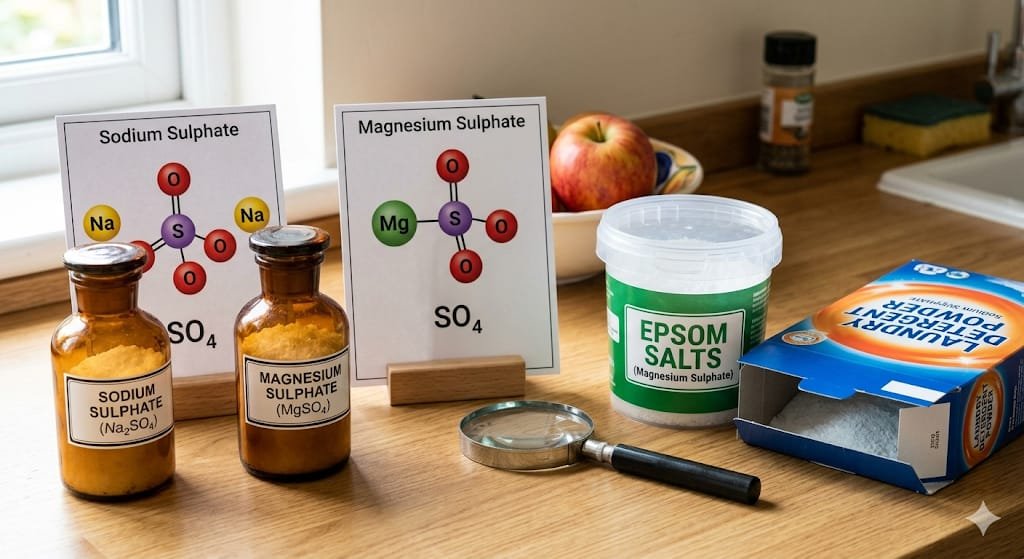
Walk through any Indian home — look under the sink, in the bathroom cabinet, or beside the washing machine — and you’re surrounded by sulphate salts. You just don’t see them listed that way on the label.
These compounds are not industrial secrets. They’re everyday ingredients that clean your clothes, soothe your muscles, and preserve your food. Understanding which ones you’re already using helps you make smarter product choices — and get more out of what you buy.
At Kanha Life Science, we manufacture several sulphate salts used directly in consumer and household applications. Here’s a factual guide to the most common ones.
1. What Is Sodium Sulphate and Where Is It Found at Home?
Sodium sulphate (Na₂SO₄) is the most widely used sulphate salt in household cleaning products. It serves as a filler and flow agent in powdered laundry detergents, ensuring even distribution during manufacturing and preventing the powder from caking.
Also known as: Glauber’s salt (decahydrate form: Na₂SO₄·10H₂O)
Brands like Surf Excel, Ariel, Rin, and Tide (powder formats) include sodium sulphate in their formulations. It makes up a significant portion of the white powdery base you pour into your washing machine.
Globally, sodium sulphate demand was 12.6 million tonnes in 2024, with detergents representing the largest application segment at over 36% of volume (ChemAnalyst, 2024). The natural form — Glauber’s salt — is obtained from brine deposits, while synthetic sodium sulphate comes as a byproduct of chemical manufacturing.
In the home, it’s safe, stable, and effective. It doesn’t contribute to cleaning on its own but makes detergent products easier to produce, store, and use.
Common Household Products Containing Sodium Sulphate
- Powdered laundry detergents (Surf Excel, Ariel, Rin, Tide)
- Automatic dishwasher powders
- Some household cleaning boosters
—
2. Why Is Epsom Salt (Magnesium Sulphate) a Bathroom Staple?
Epsom salt — chemically magnesium sulphate heptahydrate (MgSO₄·7H₂O) — is one of the most versatile sulphate compounds in any household. It takes its name from Epsom in Surrey, England, where the compound was first extracted from spring water in the 17th century.
Today, brands like Dr Teal’s, Westlab, SoulTree, and Organic India sell Epsom salt-based bath products in India and globally. When dissolved in warm water, it releases magnesium and sulphate ions that are absorbed through the skin, helping relieve muscle soreness, joint stiffness, and stress.
Contains at least 9.7% magnesium and 12.9% sulphur by composition.
Beyond bathing, Epsom salt is used as a laxative when taken orally, as a component in beauty scrubs, and as a hair conditioning treatment. Its neutral pH (6–7) makes it suitable for sensitive skin. By 2024, global magnesium sulphate production reached approximately 2.6 million tonnes per year (Wikipedia / magnesium sulfate, 2024).
Common Uses of Epsom Salt at Home
- Muscle soak bath (200–400g per tub)
- Foot soak for tired feet
- Hair volumizing treatment
- Garden fertiliser for magnesium-deficient plants
- Oral laxative (follow package directions)
—
3. Is Copper Sulphate Found in Home Products?
Copper sulphate (CuSO₄) — the vivid blue crystalline compound also called blue vitriol — has a limited but specific role in household contexts. It’s primarily found in swimming pool treatments and household fungicide sprays.
Products like Cesco Blue Stone and several unbranded pool algaecide concentrates available in hardware stores contain copper sulphate pentahydrate (CuSO₄·5H₂O) as the active ingredient. It kills algae in stagnant water and controls fungal growth on outdoor surfaces.
Some multi-purpose fungicides for garden sheds and boundary walls — available from brands like Bayer Garden and Vitax — also contain copper sulphate. It must be handled carefully: direct skin contact requires gloves, and it should never be poured down household drains in concentrated form due to aquatic toxicity.
The anhydrous form (CuSO₄) is white-grey.
Copper sulphate is also used as a wood preservative in outdoor fencing treatment products, where it’s combined with other agents to prevent rot and fungal decay.
Safety Precautions for Copper Sulphate at Home
- Always wear gloves when handling
- Keep away from children and pets
- Never pour concentrated solution down drains
- Store in clearly labelled, sealed container
—
4. Where Does Calcium Sulphate Show Up in Your Kitchen?
Calcium sulphate (CaSO₄), commonly known as gypsum, is found in two household contexts you might not expect: food production and water filtration.
In the kitchen, calcium sulphate is approved as a food additive (E516) and used as a firming agent and coagulant in tofu production. Brands like Morinaga (Japan), Nasoya, and House Foods use it to give tofu its characteristic firm texture. It’s also used in flour treatment and in some baking powders.
In household water filter cartridges — including brands like Aquaguard (Eureka Forbes) and Kent — calcium sulphate is used as a media component. It contributes to water hardness correction in certain filter stages.
It’s tasteless, odourless, and stable at room temperature.
Common Household Uses of Calcium Sulphate
- Tofu coagulant (firm tofu)
- Baking powder component
- Water filter media
- Flour treatment agent
—
5. What About Ferrous Sulphate in Household Items?
Ferrous sulphate (FeSO₄·7H₂O) — also known as iron(II) sulphate or green vitriol — appears in two types of household products: iron supplements and water treatment agents.
In India, iron-deficiency anaemia affects approximately 53% of women of reproductive age (WHO, 2023). As a result, ferrous sulphate tablets are among the most commonly prescribed iron supplements. Feronia (Mankind Pharma), Livogen (Bayer), and Orofer (Emcure) are popular brands that use ferrous sulphate as their iron source.
Ferrous sulphate is also sold for household water treatment in areas with high manganese content. It reacts with manganese to form insoluble precipitates that can be filtered out, improving water clarity and safety.
Store away from children — iron overdose is dangerous.
In home settings, it must be stored away from children and taken with food to reduce gastrointestinal side effects.
Common Forms of Ferrous Sulphate at Home
- Iron supplement tablets (Feronia, Livogen, Orofer)
- Liquid iron tonics
- Water treatment crystals (manganese removal)
—
6. Are There Sulphate Salts in Cosmetics and Personal Care Products?
Yes — though the most discussed one is actually a sulphate-based surfactant, not a simple salt. Sodium lauryl sulphate (SLS) and sodium laureth sulphate (SLES) are detergent molecules used as foaming agents in shampoos, body washes, and toothpastes.
Brands like Head & Shoulders, Pantene, Colgate, and Oral-B (in their standard formulations) use SLS or SLES as primary cleansing agents. They produce the rich lather consumers associate with thorough cleaning.
More relevant as a pure sulphate salt: zinc sulphate (ZnSO₄) is found in some medicated shampoos, dandruff treatments, and eye drops. Selsun Blue (anti-dandruff shampoo) and Zinplex products use zinc sulphate for its antimicrobial and sebum-control properties.
Whether sulphate-free is “better” depends on your hair type and sensitivity.
Personal Care Products Containing Sulphate Compounds
- Shampoos with SLS/SLES (Head & Shoulders, Pantene)
- Toothpastes (Colgate, Oral-B standard lines)
- Anti-dandruff treatments with zinc sulphate (Selsun Blue, Zinplex)
- Body washes and shower gels
—
7. Frequently Asked Questions
Is sodium sulphate in detergents harmful to skin?
No. Sodium sulphate in detergents is present as a filler, not as a cleaning agent. It’s washed away during the rinse cycle and is considered safe for household use. It’s also used in some pharmaceutical formulations as a laxative (FDA-approved).
Can I use Epsom salt (magnesium sulphate) every day in the bath?
Healthline (December 2024) recommends against daily use without medical guidance. Two to three times per week is a common recommendation for muscle recovery. Always check with a doctor if you have kidney disease, as excess magnesium is filtered by the kidneys.
Why is copper sulphate blue in colour?
Copper sulphate pentahydrate (CuSO₄·5H₂O) is blue because the water molecules surrounding the copper ion absorb red light frequencies, causing the blue colour to be reflected. The anhydrous form (CuSO₄) is white-grey.
Are sulphate-free shampoos actually better?
It depends on hair type. SLS and SLES are effective cleansers but can strip natural oils, making them less suitable for dry or colour-treated hair. Sulphate-free formulas (like those from WOW Skin Science or Mamaearth) are gentler but may lather less.
Can I use copper sulphate in my home garden?
Yes, but with extreme caution. Copper sulphate is used as a fungicide in diluted form. However, incorrect concentrations can burn plants and harm soil microorganisms. Always follow product label instructions exactly.
Is ferrous sulphate safe for children?
Only under medical supervision. Iron supplements are the leading cause of poisoning in young children. Keep all ferrous sulphate tablets and liquids in childproof containers and out of reach.
—
Conclusion
Sulphate salts are in nearly every room of your home — from the laundry detergent in the utility area to the bath salts in your bathroom, the iron tablet in your medicine cabinet, and the pool treatment in your storage room.
Kanha Life Science supplies pharmaceutical-grade, food-grade, and industrial-grade sulphate salts including magnesium sulphate, ferrous sulphate, copper sulphate, and sodium sulphate. Our products meet strict purity standards for safe use across consumer and manufacturing applications.
Reach out to our team for product specifications and bulk supply.